Your weekend penalty rates are now protected by law (and where that protection stops)
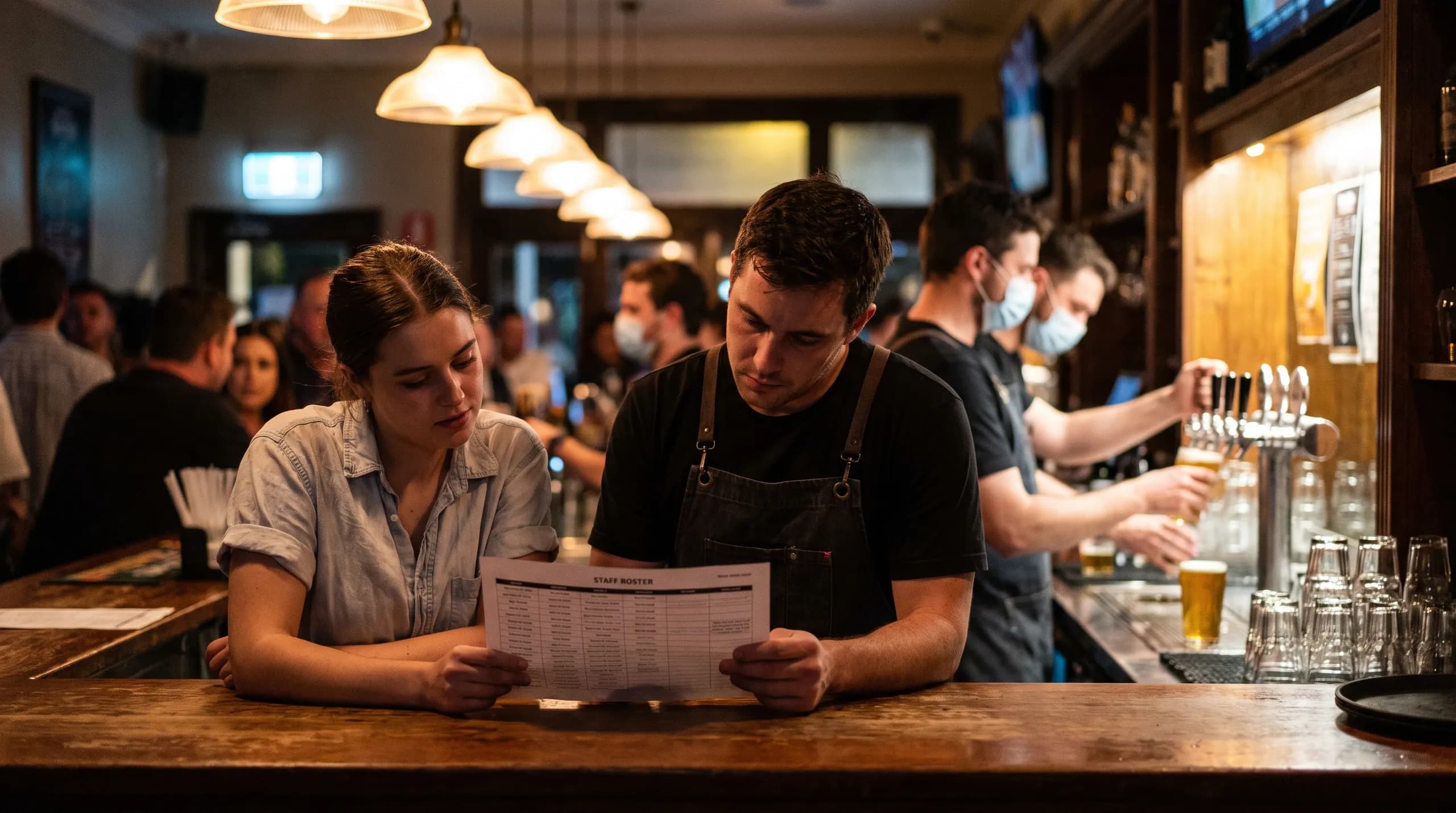
Since 30 August 2025 the Fair Work Commission can't cut penalty or overtime rates out of an award. That protects the floor under your Sunday shift. It doesn't protect you from a flat all-in rate offered across the bar, and the gap between the two is $85.93 in a single week.
A Level 2 casual in a Sydney bar is on $33.85 an hour on a Tuesday afternoon and $47.39 an hour on a Sunday. Since 30 August 2025 there is a law that stops that Sunday rate being quietly written out of the award. There is no law that stops a venue offering you $38 an hour flat, none of that weekend business, and plenty of people say yes to that.
Short version: the Fair Work Amendment (Protecting Penalty and Overtime Rates) Act 2025 commenced on 30 August 2025. It stops the Fair Work Commission reducing or substituting penalty and overtime rates in modern awards, covering around 2.6 million award-reliant workers. It protects the award. It does not stop you personally agreeing to trade penalty rates away, and it doesn't touch enterprise agreements. This is general information, not legal or financial advice. Rates quoted are Hospitality Industry (General) Award (MA000009) minimums applying from the first full pay period on or after 1 July 2026.
What actually changed on 30 August 2025
The Act inserted a new section 135A into the Fair Work Act. It's four sentences long, and the second half is the part nobody quotes. When the Commission makes, varies or revokes a modern award, it must now ensure that:
- the rate of a penalty rate or an overtime rate that employees are entitled to receive is not reduced, and
- awards don't include terms that substitute those entitlements, where the substitute would reduce the extra pay you'd otherwise get for overtime, shifts, weekends, public holidays, or unsocial, irregular or unpredictable hours.
That second limb is the anti-rolled-up-rate clause, and it exists for a specific reason. Employers in the retail, clerical and banking sectors had applied to the Commission to trade penalty rates out of those awards: a higher headline number, a smaller pay packet for anyone who actually works Sundays. The changes caught proceedings already underway as well as new ones, so those applications didn't get grandfathered.
The government puts the group covered at 2.6 million award-reliant workers. Nearly half of them (48.3%) are casual and 57.3% are under 35. If you're a casual in hospitality, that isn't a demographic footnote. That's you, twice over.
Where the protection stops
Section 135A binds the Commission, not your employer. It's a rule about what can go into an award, one level above your actual job. Subsection (2) says so outright: it does not limit the operation of section 144, the flexibility terms that let one employer and one employee vary award clauses between themselves.
The Fair Work Ombudsman lists the same carve-outs. The new principle doesn't affect individual flexibility arrangements, the Commission's power to fix ambiguities or errors in an award, or the making of enterprise agreements. Existing annualised salary terms in awards are untouched as well.
The law now protects the floor. It doesn't stop you signing something that sits above the floor on paper and below it on payday.
Can my boss cut my penalty rates and pay me a flat rate instead?
Sometimes, through one of three specific mechanisms. "We just pay everyone $38 an hour" is not one of them. Here's what the Hospitality award actually allows, and who each option is available to.
| The arrangement | Who it can cover | The catch |
|---|---|---|
| Loaded rate (MA000009 Schedule I): one higher hourly rate in place of overtime and most penalty rates | Full-time only, Level 3 and above. Casuals, part-timers, and anyone at Introductory, Level 1 or Level 2 are expressly excluded | The percentage is fixed by the award (110.20% to 131.05% depending on days and hours), rostering limits apply, and it never absorbs public holiday penalties |
| Annualised wage (clause 24): a salary covering minimum rates, allowances, overtime, penalties and leave loading | Full-time employees only | Must be at least 25% above the annualised award minimum, in writing, capped at an average 18 penalty hours and 12 overtime hours a week, and reconciled against real award pay every 12 months with any shortfall paid within 14 days |
| Individual flexibility arrangement (clause 5): varies specific award terms for one person | Any employee, including casuals | Must leave you better off overall at the moment it's made, must be in writing, must spell out how you're better off, no coercion or duress, and either side can end it on 13 weeks' notice |
| A flat rate with none of the above behind it | Nobody | Not a mechanism. The award still applies shift by shift, and your Sunday hours are still owed at the Sunday rate |
Read the first two rows again if you're casual. Both of the award's own rolled-up rate schemes shut casuals out entirely, and the loaded rate scheme also shuts out everyone at Level 1 and Level 2, which is where almost everybody starts. So if you're a casual and someone offers you an all-in rate, it is not a loaded rate arrangement. It's either an individual flexibility arrangement, or it's just a number.
What "better off overall" is worth in dollars
An individual flexibility arrangement genuinely can vary penalty rates. It just has to leave you better off overall than the award would, and the agreement itself has to set out how. That test runs on your roster, not an average one, so price your own week. Here's an ordinary weekend-heavy one for a Level 2 casual.
| Shift | Hours | Award rate | Pay |
|---|---|---|---|
| Friday 6pm to 7pm | 1 | $33.85 (125%) | $33.85 |
| Friday 7pm to midnight | 5 | $36.80 ($33.85 plus $2.95 evening loading) | $184.00 |
| Saturday 4pm to midnight | 8 | $40.62 (150%) | $324.96 |
| Sunday 10am to 6pm | 8 | $47.39 (175%) | $379.12 |
| Award total | 22 | $921.93 | |
| Same week at $38 flat | 22 | $38.00 | $836.00 |
That's $85.93 short in one week, on a roster nobody would call unusual. Work it 48 weeks and it's more than $4,100. Now look at what the flat rate would have to be just to draw level: $41.91 an hour, because that's the blended value of those 22 hours. Better off overall means beating $41.91, not matching it.
A flat rate doesn't remove the weekend loading. It moves the risk of your roster off the venue and onto you.
The honest flip side: in a week of weekday lunch shifts, $38 flat comfortably beats $33.85. That's exactly why these offers feel generous when they're made in a quiet month and sting in a busy one. Public holidays make the gap worse again, since a Level 2 casual is on $67.70 that day and no award mechanism absorbs public holiday penalties at all. Our public holiday pay explainer covers that maths.
Before you agree to a flat rate, do these five things
- Pin down your level. Everything above scales off it, and levels go by duties, never job title. Our guide to MA000009 levels walks through where you sit.
- Ask for it in writing, with the clauses named. An award individual flexibility arrangement has to identify which award terms are being varied and set out how you end up better off overall. If nobody can produce that document, there's no arrangement. There's just a rate.
- Price your last four weeks. Take the shifts you actually worked, run them through the Fair Work Ombudsman's free Pay and Conditions Tool at calculate.fairwork.gov.au, and compare totals. One weekend-heavy week is enough to flip the answer.
- Know you can say no. You can't be forced into a flexibility arrangement, it can't be made a condition of getting the job, and you can't be treated adversely for refusing. That's a protected right, not a favour.
- Know the exit, and keep checking the payslip. An award arrangement can be ended by written agreement or by either side giving 13 weeks' written notice, so it's never permanent. And a flat rate is precisely the setup that quietly stops being reconciled, so use our guide to reading your hospitality payslip to check what's on it.
Where Shiftly comes in
All of this rests on knowing what a shift is worth before you say yes to it, which is the one thing casual hospitality is worst at. Shiftly is free workforce management for venues with an on-demand staffing network built in, so the roster fills itself instead of a manager ringing around at 4pm. For you, that means nearby venues post open shifts straight to the network, you see the venue, the hours and the pay before you accept, and you get paid fast once the shift is done. You also end up with your own record of every shift you've worked, which is exactly what you want in your pocket the day someone offers you an all-in rate. Find shifts on Shiftly.
Frequently asked questions
Can my boss cut my penalty rates?
Not on their own. Your award sets the rate, and since 30 August 2025 even the Fair Work Commission can't reduce or substitute penalty and overtime rates in an award. What can change your rate is something you agree to: an individual flexibility arrangement, an annualised wage arrangement if you're full-time, or an enterprise agreement voted up at your workplace. Each of those needs you, or a majority of your colleagues, to say yes. None of them can be applied to you just because the roster changed.
Are penalty rates for casual workers covered by the new protection?
Yes, and casuals are the biggest single group in it: around 48.3% of award-reliant workers are casual. In MA000009 the casual weekend rates are 150% of the ordinary hourly rate on Saturdays and 175% on Sundays, both already inclusive of the 25% casual loading, which is $40.62 and $47.39 an hour at Level 2. Casuals are also the group the award's own rolled-up rate schemes exclude, so an all-in offer made to a casual is never a Schedule I loaded rate.
Is a rolled-up or all-in hourly rate legal in hospitality?
It depends entirely on what sits underneath it. A Schedule I loaded rate is legal, but only for full-time staff at Level 3 and above, only at percentages the award fixes, and it never covers public holidays. An annualised wage is legal for full-time staff with a written agreement, outer limits on hours and an annual reconciliation. An individual flexibility arrangement is legal for anyone, casuals included, if it leaves them better off overall. A flat number with no paperwork behind it isn't a mechanism at all: the award applies to every shift, and any shortfall is recoverable.
What happens if I refuse to sign an individual flexibility arrangement?
Nothing lawful. Refusing is protected by the general protections in the Fair Work Act, so you can't be discriminated against or treated adversely for saying no, and an employer can't make signing one a condition of hiring you. If your shifts get cut or you're pushed out afterwards, that's adverse action. The Fair Work Infoline is 13 13 94, and the call is free.

Co-founder of Shiftly. Milan works with hospitality businesses across Australia to make rostering, timesheets and award-based pay radically simpler.