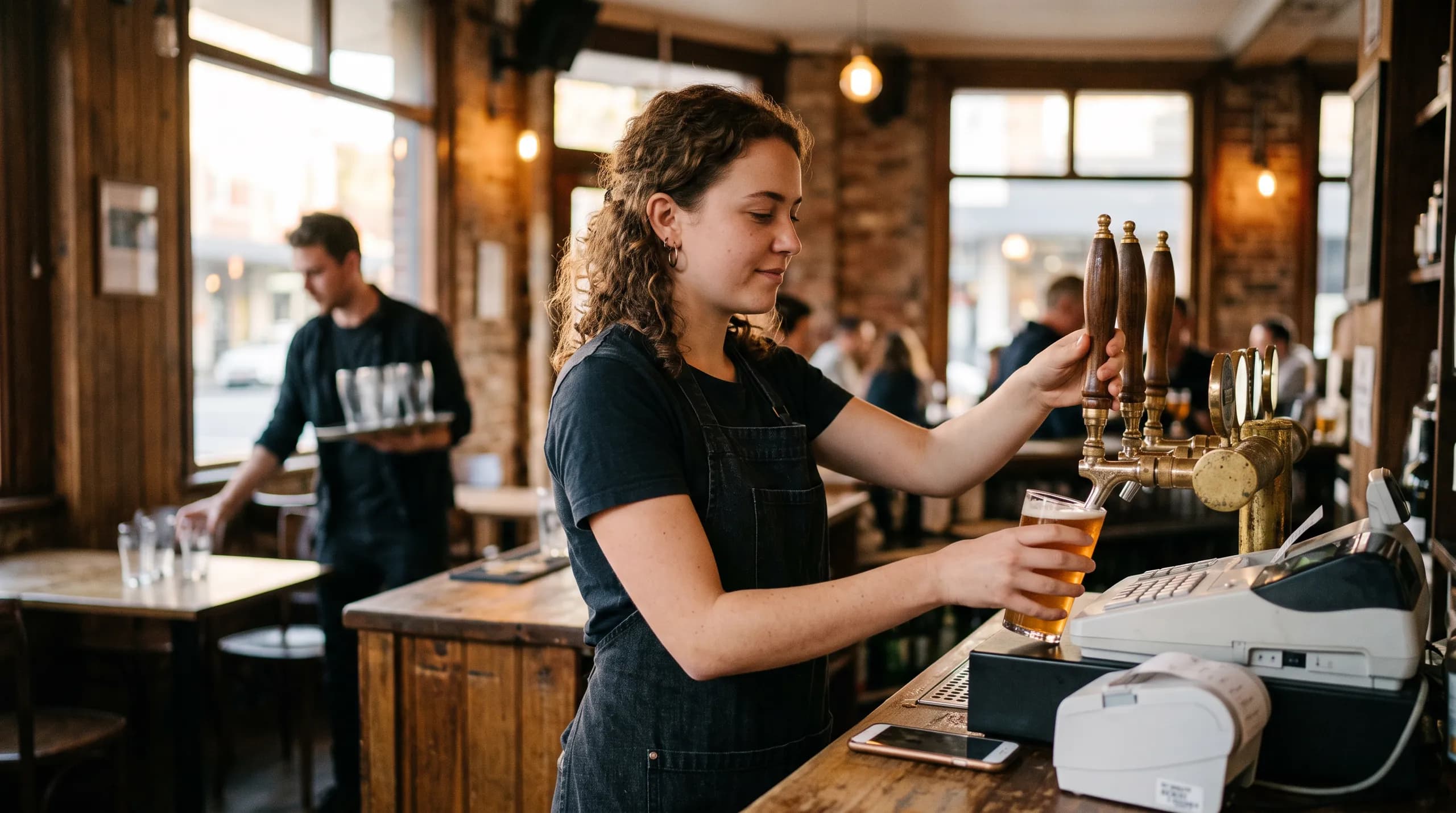
How to get more shifts as a casual in Sydney

Casual hours don't get handed out on merit, they get handed out on convenience. Here's how Sydney venues actually build a roster, which shifts are worth chasing, and how to stop being the name that gets skipped.
Your shifts went from four a week to one, nobody explained why, and asking about it feels like begging. That's the most common story in Australian hospitality, and it's usually got nothing to do with how good you are at the job.
Accommodation and food services is the most casualised industry in the country. 58% of everyone working in it is a casual, according to the ABS, the highest share of any industry in Australia. Your venue has a deep bench, and next week's roster gets built in about twenty minutes on a Wednesday afternoon.
Short version: you get more shifts by being the lowest-friction name on the roster, and more money by chasing the right shifts instead of more of them. Under the hospitality award, one Sunday hour pays the same as 1.4 midweek hours, and one public holiday hour pays the same as two.
Why your shifts dried up
Casual employment means there's no firm advance commitment to ongoing work. In plain terms, your employer has no obligation to offer you a single shift next week, and you have no obligation to take one. ABS data puts 17% of all Australian employees on no guaranteed minimum hours. It's legal, it's the deal, and it's why hours can quietly evaporate without anyone doing anything wrong.
The usual causes are boring: the venue took on three new casuals, trade softened after the Christmas run, or someone with wider availability walked in. The one cause that is genuinely yours, and the most common of the lot, is knocking back two shifts in a row. Nobody punishes you for it. They just stop asking.
Chase the right shifts, not more shifts
Before you ask for extra hours, work out which hours you actually want. The Hospitality Industry (General) Award prices identical work very differently depending on when you do it. These are the adult casual rates that applied from 1 July 2026, after award minimums rose 4.75%.
| Casual level | Mon to Fri, 7am to 7pm | Saturday | Sunday | Public holiday |
|---|---|---|---|---|
| Introductory | $32.18 | $38.61 | $45.05 | $64.35 |
| Level 1 | $33.05 | $39.66 | $46.27 | $66.10 |
| Level 2 | $33.85 | $40.62 | $47.39 | $67.70 |
| Level 3 | $34.96 | $41.96 | $48.95 | $69.93 |
| Level 4 | $36.81 | $44.18 | $51.54 | $73.63 |
| Level 5 | $39.13 | $46.95 | $54.78 | $78.25 |
| Level 6 | $40.16 | $48.20 | $56.23 | $80.33 |
Most Sydney bar and floor staff sit on Level 2 or Level 3, and our guide to MA000009 award levels covers what each one actually means. There's also a penalty most casuals never notice: an extra $2.95 an hour for ordinary hours between 7pm and midnight, and $4.42 an hour between midnight and 7am, stacked on top of the rates above.
The ratios are the useful part, and they hold at every level. A Saturday hour is worth 1.2 midweek hours, a Sunday hour 1.4, and a public holiday hour exactly 2. For a Level 2 casual, ten hours across a Sunday pays $473.90. To take home that on weekday afternoons, you'd need to work fourteen.
One public holiday hour is worth exactly two Tuesday afternoons. Same apron, same job, double the money.
Three weekend shifts can out-earn five midweek ones. So if you're chasing income rather than hours, ask for Sundays and public holidays first. They're also the shifts your manager finds hardest to fill, which is the entire trick: want what nobody else wants.
The get-picked-first checklist
- Reply first. Rosters get built in one sitting. The first few people to answer the group chat get the shifts, and everyone after that gets told it's covered.
- Give standing availability, not a list of exceptions. Free any night except Wednesdays is easy to roster. Depends on my timetable, I'll let you know is a reason to skip your name.
- Take the shifts nobody wants. Sunday close, Monday lunch, the 6am setup at a Surry Hills cafe. Hardest to fill, best paid, least competition.
- Answer the last-minute call. Whoever picks up at 9am and is on the floor by 11 is the first person offered next Friday.
- Add a second skill. An RSA competency card is mandatory to sell or serve alcohol anywhere in NSW and expires after five years, so check yours hasn't lapsed. Coffee, cocktails, or being trusted to close the till make you rosterable across more sections.
- Never no-show. One no-show can cost a venue an entire service, and it sticks to your name for good. If you truly can't make it, ring, don't text, and ring early.
- Ask once, specifically, in person. I want to get to three shifts a week, what do I need to do? gets a real answer. Any chance of more hours? in the group chat does not.
The rules that are actually on your side
- A 25% casual loading on top of the ordinary hourly rate, for every hour you work.
- A two-hour minimum engagement. Called in and sent home after forty minutes? You're still paid for two hours.
- Two hours minimum on a public holiday, even if the place is dead and you get cut early.
- A maximum of 12 hours per day or shift, and 38 hours a week, or an average of 38 across a roster cycle of up to four weeks.
- Payment at the end of each engagement, unless you've agreed to be paid weekly or fortnightly.
Now the catch nobody mentions. The award clause that requires seven days' notice to change a roster applies to full-time and part-time employees only. As a casual, you have no protection against Friday's shift disappearing on Thursday. That asymmetry is the single best argument for not depending on one venue.
One roster is a single point of failure
If one manager controls all your income, a slow month or a personality clash costs you rent money. The casuals who reliably work the hours they want are on two or three books, or on an on-demand platform where nearby venues post shifts directly. It also puts a floor under your bargaining. Knocking back a badly timed Tuesday is much easier when you've got somewhere else to be.
If you actually want guaranteed hours, ask properly
There's a legal pathway most people never touch. Under the employee choice pathway, a casual employed for at least six months (12 months at a small business) who believes they no longer meet the casual definition can give their employer written notice asking to move to permanent part-time or full-time work. The employer has to respond in writing within 21 days. The ABS found 78% of casual employees have never had a conversation with their employer about converting, so your odds of being the only person asking are decent.
Where Shiftly comes in
Shiftly is free workforce management for venues with an on-demand staffing network built in, so the roster fills itself. When a venue is short, the shift goes out to workers on the network nearby instead of into a group chat at 7am. You see the venue, the hours and the pay before you accept, you're not racing whoever happened to check their phone first, and you get paid quickly once the shift is done. It's a way to stop waiting on one roster. Find shifts on Shiftly.
Frequently asked questions
Can my employer just stop giving me shifts?
Yes. Casual employment carries no firm advance commitment to ongoing work, so there's no minimum number of shifts anyone has to offer you. What they can't do is cut your hours to punish you for exercising a workplace right, such as asking to convert to permanent employment. If that's what has happened, the Fair Work Ombudsman is where to start.
What's the shortest shift I can be rostered for?
Two consecutive hours under the Hospitality Industry (General) Award. If you're called in and sent home after thirty minutes, you're still owed two hours' pay at your applicable rate, including any weekend or public holiday penalty that applied to those hours.
Will asking for more shifts make me look desperate?
Asking once, in person, with a specific number attached reads as ambitious. Asking repeatedly in a group chat reads as noise. Most managers are relieved when someone tells them plainly what they want, because it makes the roster easier to build.
Does knocking back shifts hurt my chances?
Not formally, and you're entitled to refuse. In practice, two declines in a row often move you down the list, because managers work off memory under time pressure. If you have to say no, say when you're next free in the same message.

Co-founder of Shiftly. Milan works with hospitality businesses across Australia to make rostering, timesheets and award-based pay radically simpler.