Can't make your shift? What casuals actually owe a venue when they call in sick

Calling in sick as a casual costs you the entire shift and earns you no leave, but you don't owe your venue a replacement. Here's what the award and the NES actually require, what a sick Saturday costs in dollars, and the five-line script that keeps you on next week's roster.
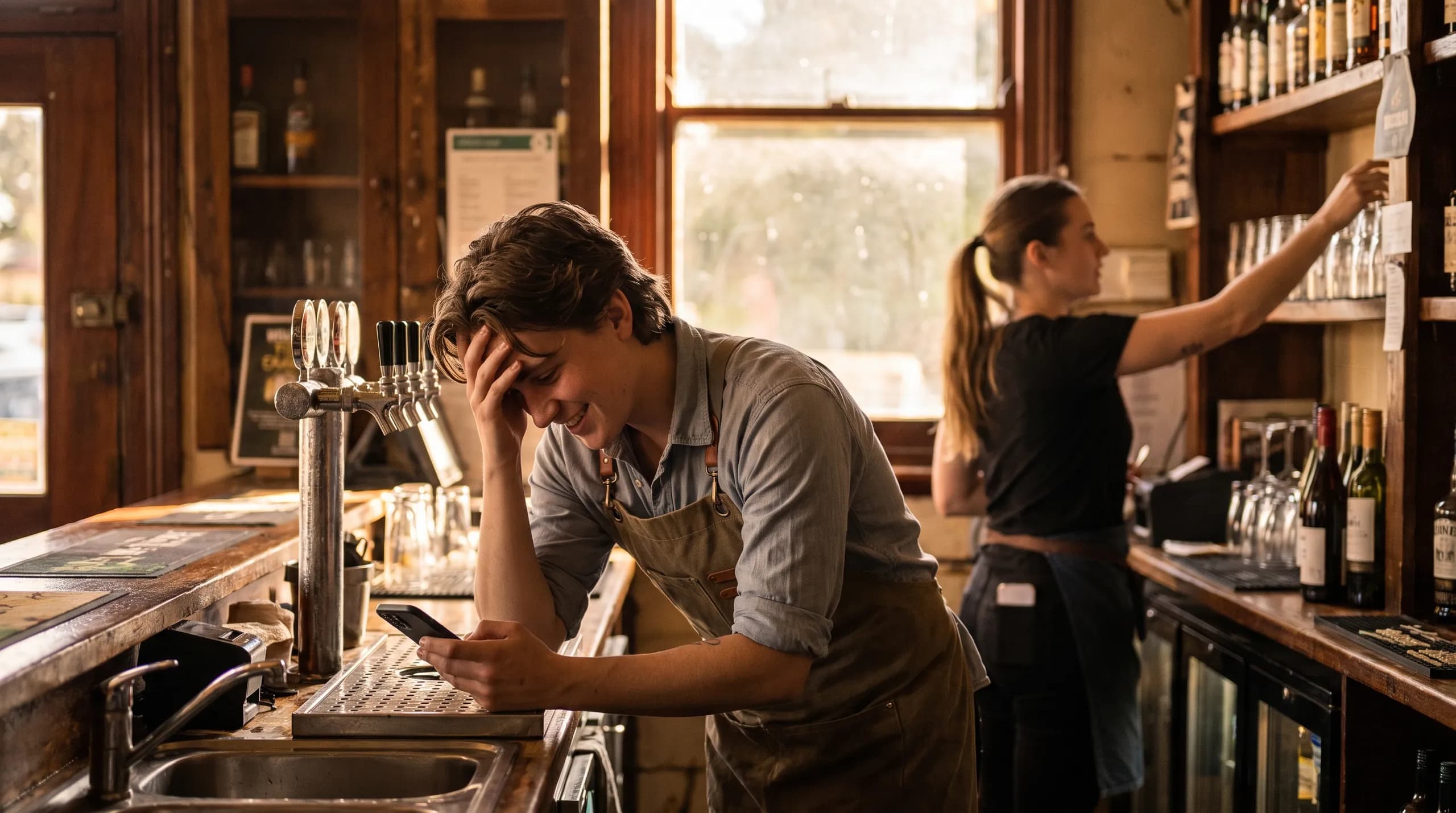
You wake up on Saturday with a fever, a 4pm start, and a group chat you don't want to open. Here's the part nobody spells out: as a casual Level 2 in a Sydney venue, that shift was worth $324.96, you will be paid none of it, and the only thing you genuinely owe your manager is a phone call.
Everything else you've been told is three different things wearing the same uniform: one real obligation, a couple of reasonable favours, and at least one instruction that is flatly unlawful. Venues rarely separate them, which is how casuals end up believing they have to find their own cover or cop a fine.
Short version. Tell them as soon as you can and say how long you expect to be off. You do not have to find your own replacement: no clause in the Hospitality Industry (General) Award or the National Employment Standards requires it. You won't be paid, because casuals get no paid sick leave. You can't be fined or docked for it. What can happen is fewer shifts next week, and that part is legal. This is general information, not legal advice.
What a sick day actually costs you
Take one 8-hour Saturday shift, same venue, same job, and run it two ways. A casual Level 2 food and beverage attendant is on $40.62 an hour on a Saturday under the rates that applied from 1 July 2026. A part-time Level 2 doing the identical shift is on $33.85, and if they call in sick they get paid, but not at the Saturday rate.
Paid sick leave is paid at an employee's base pay rate, which specifically excludes penalty rates, loadings, allowances and overtime. So the part-timer collects 8 hours at the base $27.08. Even they lose the weekend penalty.
| The same 8-hour Saturday | Casual Level 2 | Part-time Level 2 |
|---|---|---|
| Paid if you work it | $324.96 (8 hrs at $40.62) | $270.80 (8 hrs at $33.85) |
| Paid if you call in sick | $0 | $216.64 (8 hrs at base $27.08) |
| Out of pocket | $324.96 | $54.16 |
| Needs a leave balance? | There isn't one to have | Yes, 10 days a year full-time, pro rata part-time |
That gap is exactly what your casual loading is for. Clause 11.1 of the award pays a casual 25% on top of the ordinary hourly rate, which for a Level 2 is $6.77 an hour. Divide the part-timer's $216.64 sick day by $6.77 and the answer is a suspiciously round 32.
Every 32 hours you work, your casual loading has quietly earned you the cash equivalent of one paid sick day. Nobody hands it to you in a lump, which is the entire problem.
The honest catch: that loading isn't only covering sick days. It's standing in for annual leave, notice of termination and redundancy pay at the same time, all paid to you in advance at the rate of a few dollars an hour. It's a discount on four entitlements bundled into your hourly rate, not a fund with your name on it. If you want it to behave like sick pay, you have to be the one setting it aside. Our guide to how casual work actually works covers the rest of the trade-off.
What you do and don't get
| Entitlement | Casual? | The detail |
|---|---|---|
| Paid sick and carer's leave | No | The Fair Work Ombudsman is blunt about it: all employees except casuals are entitled to it. |
| Unpaid carer's leave | Yes | 2 days each time an immediate family or household member needs care because of illness, injury or an unexpected emergency. |
| Unpaid compassionate leave | Yes | 2 days per occasion. |
| Paid family and domestic violence leave | Yes | 10 days a year, casuals included, same as everyone else. |
| Having to find your own replacement | No | No such clause exists in MA000009 or the NES. A venue policy is not the same thing as a legal duty. |
| Notice before your roster changes | No | The 7 days' notice rule in clause 15.5 applies to full-time and part-time employees only. |
| Protection from being fined or docked | Yes | Deductions need your written agreement and must be mainly for your benefit. |
The one thing you owe is telling them, properly
The rule the Fair Work Ombudsman states is short. Let your employer know as soon as possible, which can be after the absence has started, and say how long you'll be off or expect to be off. That's it.
Strictly, that's written for people drawing on a leave entitlement, and as a casual you don't have one to draw on. It's still the standard your manager is measuring you against, and it's the standard that keeps you on the roster. Ring rather than text if the shift starts within a few hours. A message at 3:40pm for a 4pm start reads as avoidance even when it isn't.
What to actually say
- Lead with the shift, not the illness. Hi Sam, it's Milan. I'm on 4pm to close tonight and I can't make it, I've been up since 5 with a stomach bug. They need the gap in the roster before they need the sympathy.
- Give a return date, even a rough one. I should be right for Tuesday, I'll confirm Monday night. An open-ended absence is what makes a manager quietly redistribute your shifts to someone else.
- Offer information, not cover you can't guarantee. I've messaged Jess and Tom, neither can do it, so you'll need to look wider. You've saved them two phone calls without promising a replacement that might not turn up.
- Ask about evidence up front. Do you want a medical certificate for this one? Asking costs nothing and it heads off the awkward conversation on Tuesday about what you should have got.
- Close with availability. I'm free the rest of the weekend and happy to pick up anything if someone drops out. This is the line that gets you back on next week's roster.
Can I give my shift to someone else?
You can suggest a name. You can't hand the shift over. Your employment is with the venue, not with the roster, and only the venue can engage someone to work. Until a manager confirms the swap, the shift is still yours, and if your mate sleeps in, you're the one recorded as the no-show.
The approval step isn't bureaucracy for its own sake. The venue has to know the person holds a current RSA competency card if they're serving alcohol, that they're on the books for super and workers compensation, and that the hours won't push them past the award's caps of 12 hours a day and 38 hours a week for casuals. A swap arranged purely in a group chat delivers none of that.
And nothing obliges you to arrange it. Finding your own cover is a favour, not a duty. Plenty of good casuals do it anyway because it buys real goodwill and goodwill turns into Saturdays. Just be clear which of the two you're doing, because a venue that treats the favour as mandatory is one that will eventually try to penalise you for skipping it.
Three things a venue can't do, and one it can
- Fine you or dock your pay. An employer can only deduct money if you agreed in writing and the deduction is mainly for your benefit, or it's allowed by a law, court order, Fair Work Commission order, award or registered agreement. A no-show penalty is none of those.
- Make you pay for the replacement. Requiring an employee to hand back money for the employer's benefit is a cashback scheme, which the Fair Work Ombudsman treats as an unlawful deduction. You're entitled to that money back, and a court can add penalties on top.
- Punish you for taking unpaid carer's leave. The FWO states plainly that an employer can't take negative action against an employee for taking it. Those 2 days per occasion are protected, unpaid or not.
- What they can do: not roster you next week. Casual employment carries no firm advance commitment to ongoing work, in either direction. That's the honest asymmetry, and no amount of good process changes it.
How much notice do you actually have to give?
None that the award sets. Clause 15.5 gives full-time and part-time employees 7 days' notice of a roster change, and there is no casual equivalent going either way. Which is also why a venue can cut your Friday on Thursday afternoon, a situation we've broken down in what you're owed when a shift gets cancelled.
The real deadline is operational, not legal. A Tuesday lunch shift can be covered in twenty minutes. A Saturday night on a long weekend cannot be covered at 3pm, and everyone in the building knows it. Judge your notice against how hard the shift is to fill, not against a number in a staff handbook.
One more thing if the calls keep coming on your day off. Since 26 August 2024 for most employers, and 26 August 2025 for small businesses, employees have a right to refuse to monitor, read or respond to work contact outside their working hours unless refusing is unreasonable. It doesn't make the call unlawful. It does mean not answering at 9am on your Sunday off is usually not a performance issue.
Where Shiftly comes in
A sick day hurts this much because most casuals depend on one roster and one manager's memory of how they handled it. Shiftly is free workforce management for venues with an on-demand staffing network built in, so the roster fills itself: when a venue is short, the shift goes out to workers on the network nearby instead of into a 7am group chat. That cuts in your favour twice. Your venue can cover you without anyone ringing around and resenting it, and when you're back on your feet you can see nearby open shifts with the venue, the hours and the pay showing before you accept, then get paid fast once you've worked one. It's how one bad week stops costing you a month of hours. Find shifts on Shiftly.
Frequently asked questions
Do casuals get paid sick leave in Australia?
No. Under the National Employment Standards, all employees except casuals are entitled to paid sick and carer's leave. Casuals get a 25% loading under the Hospitality Industry (General) Award instead, which is meant to compensate for the leave they don't accrue. You do still get 2 days unpaid carer's leave per occasion, 2 days unpaid compassionate leave per occasion, and 10 days paid family and domestic violence leave a year.
Can I be sacked for calling in sick as a casual?
Being left off next week's roster is legal, because casual employment carries no firm advance commitment to ongoing work. Being dismissed because you were temporarily away with illness or injury is a prohibited reason under section 772 of the Fair Work Act. Casuals employed on a regular and systematic basis with a reasonable expectation of ongoing work may also be able to bring an unfair dismissal claim after 6 months, or 12 months at a small business. Start with the Fair Work Ombudsman if you think that's what happened.
How much notice do I have to give to cancel a shift?
The award sets no notice period for a casual. The 7 days' notice rule for roster changes in clause 15.5 covers full-time and part-time employees only, which is the same reason your own shifts can vanish at short notice. In practice, give every hour of warning you have and phone rather than text if the shift starts the same day.
Do I need a medical certificate if I'm not getting paid anyway?
An employer can ask for evidence for as little as one day off, and both a medical certificate and a statutory declaration are acceptable, as long as the evidence would convince a reasonable person the absence was genuine. For a casual there's no sick pay riding on it, so what a certificate really buys you is credibility, which is the currency that decides next week's roster. If a GP gap fee is the barrier, a statutory declaration costs nothing. Getting your award level right matters more to your income than any of this.

Co-founder of Shiftly. Milan works with hospitality businesses across Australia to make rostering, timesheets and award-based pay radically simpler.